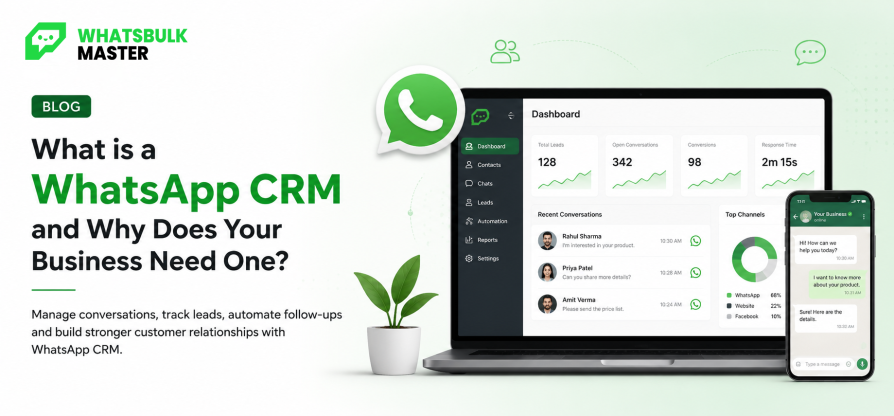
What is a WhatsApp CRM and Why Does Your Business Need One?
- 06 Feb, 2025
In today's digital-first world, customers expect businesses to respond quickly, personally, and through channels they already use every day. WhatsApp has become one of the most preferred communication platforms globally, making it an essential tool for businesses that want to connect with prospects and customers in real time. However, as customer conversations increase, managing them through a standard WhatsApp account becomes difficult. This is where a WhatsApp CRM becomes valuable.
A WhatsApp CRM is a customer relationship management platform that integrates WhatsApp communication with lead management, customer tracking, automation, and team collaboration. Instead of relying on a single mobile device to handle customer interactions, businesses can centralize conversations, monitor customer journeys, and manage sales opportunities from a unified dashboard.
Many businesses initially start using WhatsApp simply to answer inquiries. Over time, they begin receiving hundreds of messages every week from potential customers, existing clients, support requests, and follow-up conversations. Without a structured system, important inquiries can be missed, response times can increase, and valuable leads may slip away. A WhatsApp CRM solves these challenges by organizing conversations and providing businesses with complete visibility into customer interactions.
One of the biggest advantages of using a WhatsApp CRM is the ability to track and manage leads effectively. When a customer sends an inquiry, the conversation can be automatically recorded and assigned to a sales representative. Every interaction becomes part of the customer profile, allowing businesses to understand where a prospect is in the buying journey. This eliminates guesswork and enables teams to deliver more personalized communication.
Customer expectations have also changed significantly in recent years. People no longer want to wait hours or days for responses. They expect businesses to provide immediate assistance. A WhatsApp CRM helps organizations meet these expectations through automation. Welcome messages, lead qualification processes, appointment reminders, order updates, and follow-up communications can all be automated, ensuring customers receive timely responses while reducing manual workload for employees.
Another important benefit is team collaboration. As businesses grow, multiple employees often need access to customer conversations. Sharing a single WhatsApp account across different devices is not practical and can create confusion. A WhatsApp CRM provides a shared workspace where team members can view conversations, assign chats, add internal notes, and collaborate efficiently. This improves productivity while maintaining a consistent customer experience.
Beyond communication, a WhatsApp CRM provides valuable business insights. Companies can monitor response times, track campaign performance, analyze customer engagement, and measure conversion rates. These insights help management understand what is working and identify areas for improvement. Instead of making decisions based on assumptions, businesses can rely on real data to optimize their customer communication strategy.
The usefulness of a WhatsApp CRM extends across multiple industries. E-commerce businesses use it to manage orders and customer support. Educational institutions use it to communicate with students and parents. Real estate agencies rely on it for lead nurturing and property inquiries. Healthcare providers use it for appointment reminders and patient engagement. Regardless of the industry, the goal remains the same: creating better customer experiences while improving operational efficiency.
As competition increases, businesses can no longer afford disorganized customer communication. Customers expect fast, relevant, and personalized interactions. Companies that fail to deliver these experiences risk losing opportunities to competitors who communicate more effectively. A WhatsApp CRM helps bridge this gap by combining the familiarity of WhatsApp with the advanced capabilities of a modern customer relationship management system.
Platforms like WhatsBulkMaster take this concept even further by offering workflow automation, multi-agent support, campaign management, analytics, contact organization, and customer engagement tools in a single platform. This enables businesses to not only manage conversations but also automate growth and improve customer relationships at scale.
In conclusion, a WhatsApp CRM is no longer just a convenience—it has become an essential business tool. It helps organizations manage customer conversations, automate repetitive tasks, improve team collaboration, and convert more leads into customers. As WhatsApp continues to dominate business communication, companies that adopt a powerful WhatsApp CRM will be better positioned to deliver exceptional customer experiences and achieve sustainable growth.
Share this Blog
More Blogs

WhatsBulkMaster Lifetime Deal – Pay Once, Use Forever
If you're running a business today, chances are WhatsApp plays a major role in your customer communi...
- 01 Jun, 2026
Top Benefits of Using a WhatsApp CRM for Your Business
A few years ago, businesses primarily relied on phone calls and emails to communicate with customers...
- 29 May, 2026
What is WhatsApp Automation? A Beginner's Guide
Have you ever received an instant reply from a business on WhatsApp, even late at night? Or perhaps...
- 29 May, 2026
WhatsApp Business API Pricing Explained: What Businesses Need to Know
One of the first questions businesses ask when considering the WhatsApp Business API is simple: "How...
- 01 Jun, 2025
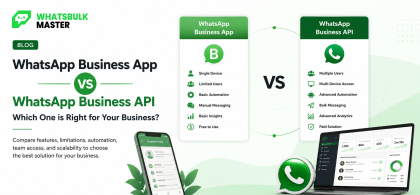
WhatsApp Business App vs WhatsApp Business API: Which One is Right for Your Business?
If you're running a business and using WhatsApp to talk to customers, you've probably come across tw...
- 06 Feb, 2025