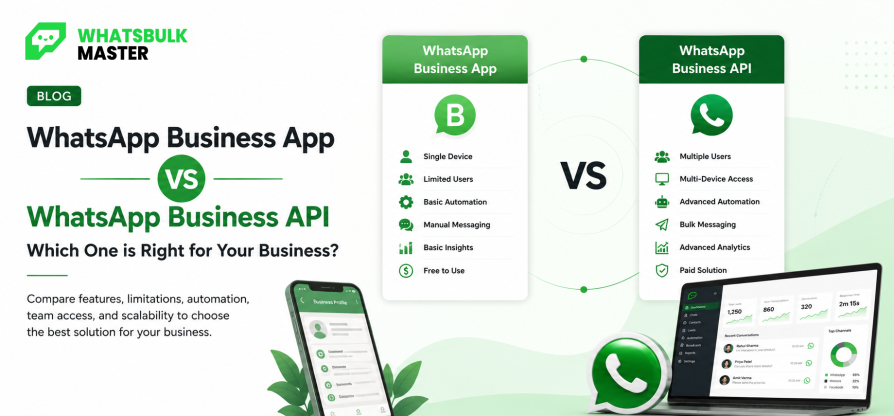
WhatsApp Business App vs WhatsApp Business API: Which One is Right for Your Business?
- 06 Feb, 2025
If you're running a business and using WhatsApp to talk to customers, you've probably come across two terms quite often: WhatsApp Business App and WhatsApp Business API.
At first glance, they may seem like the same thing. After all, both allow businesses to communicate with customers through WhatsApp. But once your business starts growing, the differences become impossible to ignore.
Many business owners start with the free WhatsApp Business App because it's simple and easy to set up. You download the app, create a business profile, add your contact information, and start chatting with customers. For a small business handling a handful of inquiries every day, that's usually enough.
The challenge begins when customer conversations increase.
Imagine receiving 100 inquiries a day. Some customers are asking for prices, others need support, and a few are ready to make a purchase. Suddenly, one person handling everything from a single mobile phone becomes a bottleneck. Messages get missed, follow-ups are forgotten, and response times become slower. This is often the point where businesses start looking for a more scalable solution.
That's where the WhatsApp Business API comes in.
Unlike the standard Business App, the API is designed specifically for growing businesses that need advanced communication capabilities. It allows companies to connect WhatsApp with CRM systems, automation platforms, customer support tools, and marketing software. Instead of relying on one mobile device, businesses can manage customer conversations from a centralized dashboard with multiple team members.
Think of it this way. The WhatsApp Business App is like managing your business from a small retail shop. It works well when customer traffic is manageable. The WhatsApp Business API is like moving into a larger facility with dedicated departments, automated processes, and room for growth.
One of the biggest advantages of the API is team collaboration. With the standard app, only a limited number of devices can access the account, making it difficult for sales and support teams to work together. With the API, multiple agents can respond to customers from a shared inbox, ensuring no conversation gets left unattended.
Automation is another major difference. The WhatsApp Business App provides a few basic features such as greeting messages and away messages. While useful, these features are limited. The API allows businesses to build complete automation workflows. A customer can submit an inquiry, receive an instant response, be automatically assigned to a sales representative, and receive follow-up messages without any manual effort.
This becomes particularly valuable for businesses that generate leads through advertisements, websites, landing pages, or social media campaigns. Instead of manually responding to every inquiry, automation ensures every lead receives immediate attention.
Marketing capabilities also differ significantly.
The WhatsApp Business App is primarily designed for one-to-one communication. The API, on the other hand, allows businesses to send approved template messages, notifications, reminders, order updates, and marketing campaigns at scale while complying with Meta's policies.
For example, an e-commerce store can automatically send order confirmations, shipping updates, and delivery notifications. A coaching institute can send admission reminders. A healthcare clinic can send appointment confirmations. These automated interactions improve customer experience while reducing operational workload.
Security and reliability are also important considerations. As customer data grows, businesses need better control over conversations and access permissions. The API provides a more professional environment where administrators can manage users, monitor activities, and maintain consistency across customer interactions.
Of course, not every business needs the API immediately.
If you're a local business receiving only a few inquiries each day, the WhatsApp Business App may be sufficient. It's free, simple, and easy to use. However, if your team is growing, your customer base is expanding, or you're looking to automate communication and improve efficiency, the API becomes a natural next step.
The transition from the Business App to the API is not simply a technology upgrade. It's often a business growth milestone. It signals that your company has reached a point where manual communication is no longer enough and a scalable customer engagement system is required.
Platforms like WhatsBulkMaster make this transition easier by providing businesses with a complete WhatsApp CRM and automation solution built on the official WhatsApp Business API. Instead of dealing with technical complexities, businesses can focus on managing leads, automating conversations, running campaigns, and delivering better customer experiences.
In the end, the choice depends on where your business is today and where you want it to be tomorrow. The WhatsApp Business App is perfect for getting started, but businesses that want to scale their customer communication, automate processes, and support larger teams will eventually need the power and flexibility of the WhatsApp Business API.
Share this Blog
More Blogs

WhatsBulkMaster Lifetime Deal – Pay Once, Use Forever
If you're running a business today, chances are WhatsApp plays a major role in your customer communi...
- 01 Jun, 2026
Top Benefits of Using a WhatsApp CRM for Your Business
A few years ago, businesses primarily relied on phone calls and emails to communicate with customers...
- 29 May, 2026
What is WhatsApp Automation? A Beginner's Guide
Have you ever received an instant reply from a business on WhatsApp, even late at night? Or perhaps...
- 29 May, 2026
WhatsApp Business API Pricing Explained: What Businesses Need to Know
One of the first questions businesses ask when considering the WhatsApp Business API is simple: "How...
- 01 Jun, 2025
What is a WhatsApp CRM and Why Does Your Business Need One?
In today's digital-first world, customers expect businesses to respond quickly, personally, and thro...
- 06 Feb, 2025