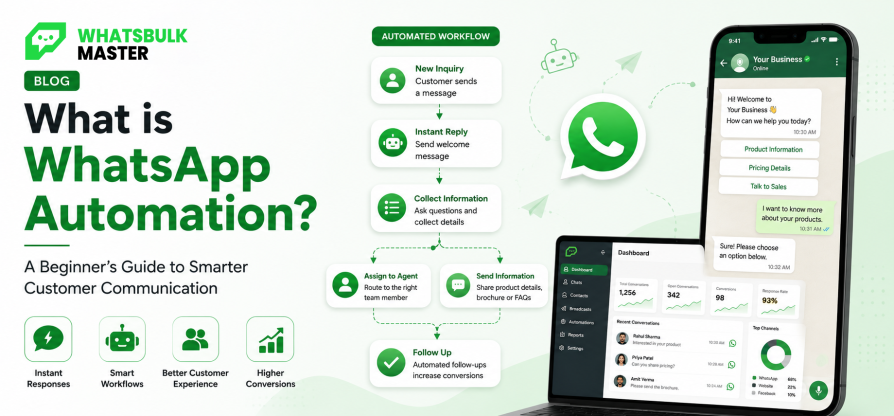
What is WhatsApp Automation? A Beginner's Guide
- 29 May, 2026
Have you ever received an instant reply from a business on WhatsApp, even late at night? Or perhaps you've inquired about a product and immediately received pricing details, brochures, or appointment options without waiting for a human response.
That's WhatsApp automation in action.
As businesses receive more customer inquiries every day, manually responding to every message becomes increasingly difficult. Customers expect quick responses, businesses need to handle more conversations, and teams often struggle to keep up with growing demand. This is where WhatsApp automation becomes one of the most valuable tools for modern businesses.
Simply put, WhatsApp automation allows businesses to automate repetitive communication tasks without sacrificing the customer experience. Instead of manually sending the same messages over and over again, businesses can create automated workflows that respond instantly, guide customers through predefined processes, and ensure no inquiry goes unanswered.
Many people assume automation means replacing human interaction. In reality, it's quite the opposite. The goal of automation is to handle routine tasks so your team can focus on conversations that genuinely require human attention.
Imagine a customer visits your website and submits an inquiry form. Without automation, someone from your team would need to check the inquiry, contact the customer, gather information, and begin the conversation manually. With WhatsApp automation, the process can start immediately. The customer receives a welcome message, answers a few questions, and is automatically directed to the appropriate sales representative or department.
The result is a faster experience for the customer and less manual work for your team.
One of the reasons WhatsApp automation has become so popular is because customers already use WhatsApp daily. Unlike email, where messages can sit unread for hours, WhatsApp messages are typically opened within minutes. This creates an opportunity for businesses to engage customers while their interest is still high.
For example, a real estate company can automatically respond to property inquiries and send available listings. An educational institution can provide course information and admission details. An e-commerce business can send order confirmations, shipping updates, and delivery notifications automatically. In each case, automation improves efficiency while maintaining a professional customer experience.
Another major advantage is consistency. Human teams can become busy, distracted, or overwhelmed during peak periods. Automation ensures every customer receives the same level of attention regardless of the time of day or the number of incoming inquiries. Whether a business receives ten messages or a thousand, automation helps maintain service quality.
As businesses grow, follow-ups become equally important. Research consistently shows that many sales opportunities are lost simply because businesses fail to follow up with leads. A potential customer may show interest today but forget about the conversation tomorrow. Automation helps solve this problem by scheduling follow-up messages and reminders automatically.
This means leads remain engaged without requiring constant manual effort from sales teams.
One common concern among business owners is whether automation feels robotic. The answer depends on how it's implemented. Modern automation platforms allow businesses to personalize messages, create intelligent workflows, and transfer conversations to human agents whenever necessary. Customers often appreciate receiving instant assistance rather than waiting for someone to become available.
The most effective automation strategies combine technology and human interaction. Automation handles repetitive tasks such as greetings, information collection, appointment scheduling, and follow-ups, while human agents focus on consultation, problem-solving, and relationship building.
For businesses that are new to automation, getting started is often much easier than expected. Today's platforms provide drag-and-drop workflow builders that allow users to create automation sequences without any coding knowledge. This means even small businesses can implement professional automation systems without hiring developers or technical specialists.
As customer expectations continue to rise, speed has become a competitive advantage. Customers want answers immediately, and businesses that respond first often win the opportunity. WhatsApp automation helps organizations deliver faster responses, improve customer experiences, and increase operational efficiency.
Platforms like WhatsBulkMaster make WhatsApp automation accessible to businesses of all sizes. With workflow automation, customer engagement tools, campaign management, and multi-agent collaboration, businesses can automate communication while maintaining meaningful customer relationships.
In the coming years, automation will become a standard part of customer communication rather than a competitive advantage. Businesses that adopt automation early will be better positioned to scale their operations, improve customer satisfaction, and stay ahead of competitors.
For beginners, the most important thing to remember is that automation isn't about removing the human element. It's about creating a better experience for both customers and teams. When used correctly, WhatsApp automation helps businesses communicate faster, work smarter, and grow more efficiently.
Share this Blog
More Blogs

WhatsBulkMaster Lifetime Deal – Pay Once, Use Forever
If you're running a business today, chances are WhatsApp plays a major role in your customer communi...
- 01 Jun, 2026
Top Benefits of Using a WhatsApp CRM for Your Business
A few years ago, businesses primarily relied on phone calls and emails to communicate with customers...
- 29 May, 2026
WhatsApp Business API Pricing Explained: What Businesses Need to Know
One of the first questions businesses ask when considering the WhatsApp Business API is simple: "How...
- 01 Jun, 2025
WhatsApp Business App vs WhatsApp Business API: Which One is Right for Your Business?
If you're running a business and using WhatsApp to talk to customers, you've probably come across tw...
- 06 Feb, 2025
What is a WhatsApp CRM and Why Does Your Business Need One?
In today's digital-first world, customers expect businesses to respond quickly, personally, and thro...
- 06 Feb, 2025